Which Jobs Are Most :and Least: Affected by AI?
Understanding the Data Behind AI Applicability
Artificial intelligence (AI) is no longer a futuristic concept - it's here, and it's rapidly transforming the way we work. But not all jobs are equally affected. Some roles are highly susceptible to AI automation, while others remain relatively safe.
Recently, researchers released a detailed study ranking occupations by their AI applicability score - essentially, how much AI could take over or support the tasks in those jobs. Below, I'll break down what these findings mean, why some careers are more exposed than others, and what we can learn from the data.
The Metrics: What Do These Columns Mean?
Before diving into the lists, it helps to understand the four main metrics used:
Coverage: How much of the job's tasks can AI potentially touch? Higher coverage means more of the role could be automated.
Completion: How capable AI currently is at completing those tasks.
Scope: The range of job responsibilities that AI could realistically address.
Score: The overall AI applicability score (a composite measure combining the above).
The Employment column shows how many people currently work in each role in the U.S., highlighting the scale of potential impact.
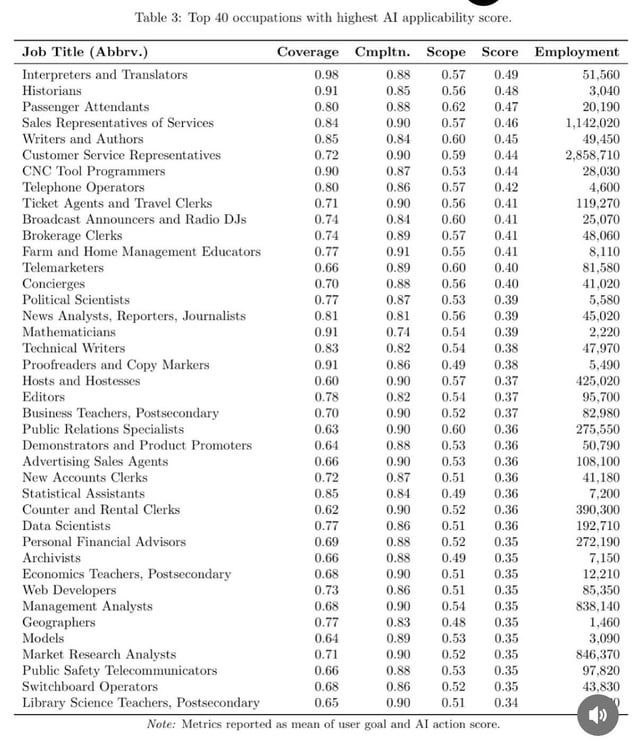
The Top 40 Jobs Most Exposed to AI
The data reveals a wide variety of professions at high risk of AI impact. Here are the key patterns:
Language and Communication-Based Jobs Are Highly Vulnerable
Interpreters & Translators top the list, with AI covering 98% of their tasks. Tools like ChatGPT and Google Translate already challenge this field with real-time translation capabilities.
Writers, Authors, and Editors are also near the top. AI is increasingly capable of drafting, editing, and even fact-checking text through platforms like Grammarly and Jasper AI.
Customer-Facing and Information Jobs Are in the Crosshairs
Customer Service Representatives (with nearly 2.9 million employed) score very high, since chatbots and automated call systems can already handle many interactions.
Ticket Agents, Travel Clerks, and Telemarketers also rank high due to the rise of automated booking systems and robocalling technology.
Analytical Professions See Rising AI Involvement
Data Scientists and Market Research Analysts appear on the list - not because AI will replace them entirely, but because much of their routine analysis can be automated through tools like Tableau and automated machine learning platforms.
Academic and Specialist Roles Aren't Immune
Historians, Political Scientists, and Economics Teachers are surprisingly high-ranking. This suggests AI tools are now capable of supporting — or even replicating — significant portions of research and teaching-related tasks through large language models and research databases.
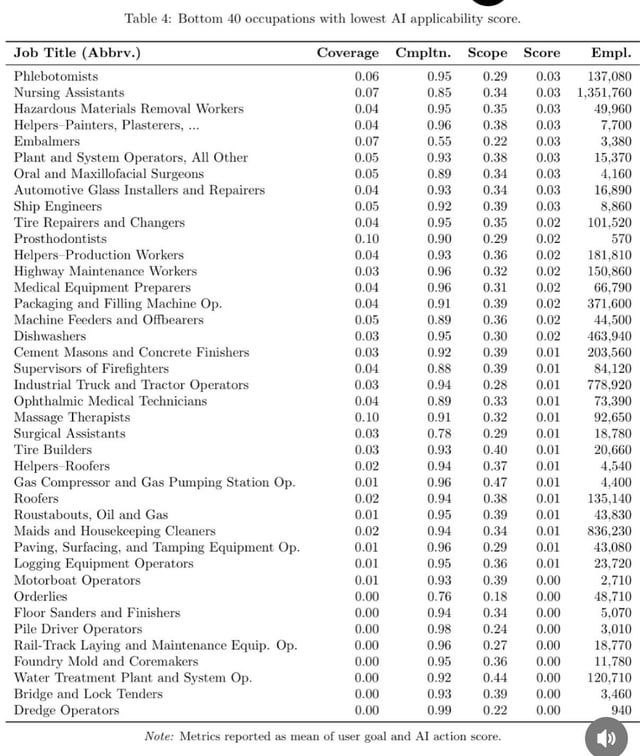
The Bottom 40 Jobs Least Exposed to AI
On the other end of the spectrum, we see jobs that rely heavily on physical presence, manual skill, or personal human interaction:
Hands-On Medical and Care Roles Are Safe (for Now)
Phlebotomists (drawing blood), Nursing Assistants, and Massage Therapists all have very low AI applicability. These roles demand a combination of technical skill and physical presence that AI cannot replicate.
Even Oral and Maxillofacial Surgeons rank low because surgery requires manual dexterity and real-time judgment beyond current AI capabilities.
Skilled Trades and Manual Labor Are Less Affected
Highway Maintenance Workers, Cement Masons, and Dishwashers all score low - AI cannot (yet) handle physical outdoor work, irregular environments, or tasks involving hands-on cleaning and maintenance.
Roofers, Logging Equipment Operators, and Pile Driver Operators are similarly protected by the physical and environmental complexity of their work.
Support and Maintenance Jobs Remain Human-Centered
Helpers–Production Workers, Medical Equipment Preparers, and Bridge and Lock Tenders demonstrate that many behind-the-scenes support roles requiring physical presence and situational awareness remain firmly in human hands.
Key Insights
1. Knowledge Work Is More Vulnerable Than Physical Work
Jobs that primarily involve information processing, writing, or communication are far more susceptible to AI disruption than physically demanding or location-dependent roles.
2. High Employment Roles Could Mean Widespread Impact
Occupations like Customer Service Representatives and Maids & Housekeeping Cleaners employ hundreds of thousands to millions. Even modest AI adoption could affect millions of workers, making this a significant workforce development challenge.
3. AI Won't Replace All Jobs — But It Will Reshape Them
A low AI applicability score doesn't mean zero technology impact - it means fewer tasks are directly automatable. For high-scoring jobs, AI might first act as an assistant rather than a replacement, amplifying productivity through human-AI collaboration.
4. Hybrid Futures Are Most Likely
Expect many jobs to evolve rather than disappear. For example, Data Scientists may use AI to handle routine tasks while focusing more on strategic insight and decision-making.
What This Means for Us
For Individuals:
If you're in a high-exposure job, consider upskilling into areas that emphasize creativity, strategy, or human connection
If you're in a lower-exposure role, technology will still touch your work - but likely in the form of better tools rather than full automation
Consider developing AI literacy to work effectively alongside these technologies
For Organizations:
Plan for augmentation, not just automation. Workers and AI together can achieve more than either alone
Invest in retraining programs to help employees transition as tasks evolve
Consider the ethical implications of AI implementation in workforce planning
Final Thought
The story these data tell isn't one of inevitable replacement, but of transformation. AI will affect nearly every job - some more directly than others. The key is not to fear these shifts, but to prepare for them, ensuring we're ready to work alongside AI in ways that keep human skill, empathy, and creativity at the center.
As we navigate this transition, resources like the Bureau of Labor Statistics, MIT's Work of the Future, and McKinsey's Future of Work research can help us understand and adapt to these changes.
For more insights on AI and workforce transformation, explore research from Brookings Institution, Pew Research Center, and the World Economic Forum's Future of Jobs reports.